Reflecting on what you are learning
There are a number of activities where you are asked to write down your reflections and thoughts about your experiences of managing behaviour. In this video Becca explains how using the Reflection Grid will help.
Some of these thoughts are shared openly with other participants in discussions; some may be things you keep to yourself.
Trying to take in new ideas and embed them into your practice is not easy. But we would stress the importance of critical reflection if you want to translate these ideas into practise, and also if you want to be effective in making changes in what you do. We recommend that you keep a personal record of all your work on the course, as a resource for refreshing your memory and continuing to refine your practice in the future.
Exactly how and where you do this is up to you. It could be a private ‘digital scrapbook’ file. If you have a blog or other online space where you share ideas, you may choose to put selected work there (always respecting the privacy and confidentiality of others, of course).
Using the Reflection Grid
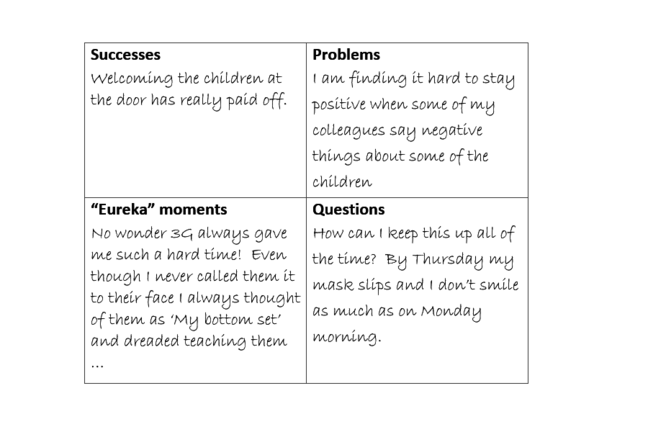
Each of the cells has a particular name and function, explained in the video above.
For your convenience, here is a blank copy of the Reflection Grid [DOCX] you can edit and an example [PDF] of how you might complete the grid.
On some occasions we will prompt you to use the Reflection Grid, but feel free to use it whenever you want. We hope you find it a useful tool to help you in your learning journey – so that when you go online and you start to talk with others, you’ve got ideas to share.
Collaboration and experimentation
Professional development is essential for teachers to progress as teaching practitioners. But there are many challenges in integrating professional development into regular practice.
In particular:
- We stress the value of collaborating with peers – both at your own place of work and online – to put into practice the ideas and approaches suggested by Paul and the Course Team
- We emphasise the value of experimenting, with a view to adapting methods to your own classroom or lab settings.
If you are doing this course with colleagues from your school or cluster of schools, we would encourage you to ‘follow’ each other. Then you’ll easily be able to see comments from the people you know.