
What is the message of ebooks?
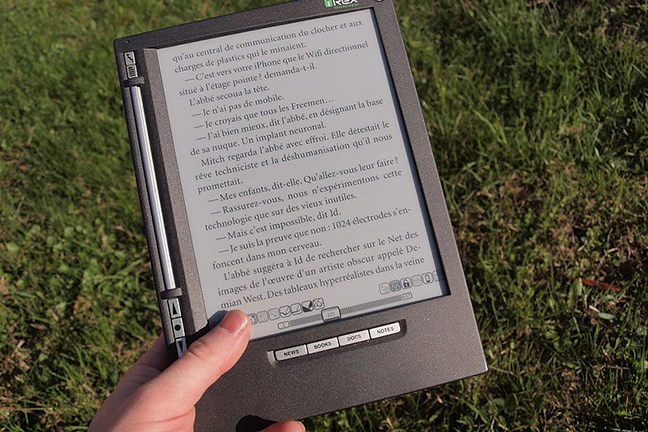
In his famous Playboy interview, Marshall McLuhan elaborates on his most powerful statement that ‘the medium is the message’ (Understanding 7) by noting that ‘the content or message of any particular medium has about as much importance as the stenciling on the casing of an atomic bomb’ (‘Playboy’ 238).
What McLuhan focuses on instead are the psychological and social effects of new media, ‘the change of scale or pace or pattern [they] introduce into human affairs’ (Understanding 8).
Perhaps, ebooks are still too young a medium to fully assess their psychological and social effects, but several studies already give partial answers. For instance, in an article published in the Proceedings of the National Academy of Sciences, Daniel Aeschbach and his co-authors document the following findings:
The use of light-emitting electronic devices for reading, communication, and entertainment has greatly increased recently. We found that the use of these devices before bedtime prolongs the time it takes to fall asleep, delays the circadian clock, suppresses levels of the sleep-promoting hormone melatonin, reduces the amount and delays the timing of REM sleep, and reduces alertness the following morning. (1232)
-
information about average hours and minutes it takes to read a book
-
display of progress reports such as percentage of the book read or average reading time until the end of the chapter or book
-
marking of those passages that were most frequently highlighted by other users
-
access to dictionaries and general reference information (X-Ray)
-
option to go online
-
Kindle FreeTime, which allows parents to make selected books available to their children, set reading goals, and monitor progress. Kindle FreeTime also allows children to monitor their own progress and earn achievement badges for reaching milestones.
By ‘activating’ Microsoft’s Reader software, in other words, one cedes to ebook publishers, Microsoft, and other interested parties much of one’s ability to circulate, dispose of, and reproduce the encrypted ebooks one has purchased […]. Digital encryption thus allows authors, publishers, and others to monitor and regulate the disposition of ebooks in ways that exceed existing intellectual property laws (249).
three alarming and interrelated trends […]: first, the accelerated fencing off of the (knowledge) commons; second, the gradual transfer of private property from ordinary people to multinational media conglomerates and other enfranchised interests; and finally, the dampening of human creativity, resulting from intensified restrictions on the circulation and public use of signs (250).
References
Aeschbach, Daniel, Anne-Marie Chang, Jeanne F. Duffy, Charles A. Czeisler. ‘Evening use of light-emitting eReaders negatively affects sleep, circadian timing, and next-morning alertness.’ Proceedings of the National Academy of Sciences, 112.4 (2015): 1232–1237.
McLuhan, Marshall. ‘Playboy Interview: Marshall McLuhan − A Candid Conversation with the High Priest of Popcult and Metaphysician of Media.’ Essential McLuhan. Ed. Eric McLuhan and Frank Zingrone. Concord: House of Anansi Press, 1995. 233–69.
McLuhan, Marshall. Understanding Media: The Extensions of Man. New York: MIT Press, 1994.
Striphas, Ted. ‘Disowning Commodities: Ebooks, Capitalism, and Intellectual Property Law.’ Television & New Media 7.3 (2006): 231–60.
Literature in the Digital Age: from Close Reading to Distant Reading


Literature in the Digital Age: from Close Reading to Distant Reading





