
Rollout of genomics across the world
Genomics is a complex and expensive field of study, due to the high volumes of valuable data involved and the ongoing development of innovations which enable us to understand more about this data every year.
Most of the biggest discoveries to date have come from initiatives that were entirely or partially funded by national governments. This step traces the development of some of these initiatives around the world, before moving on to discuss the current picture and the increasing recognition of patient advocacy as an essential part of this.
National government investments
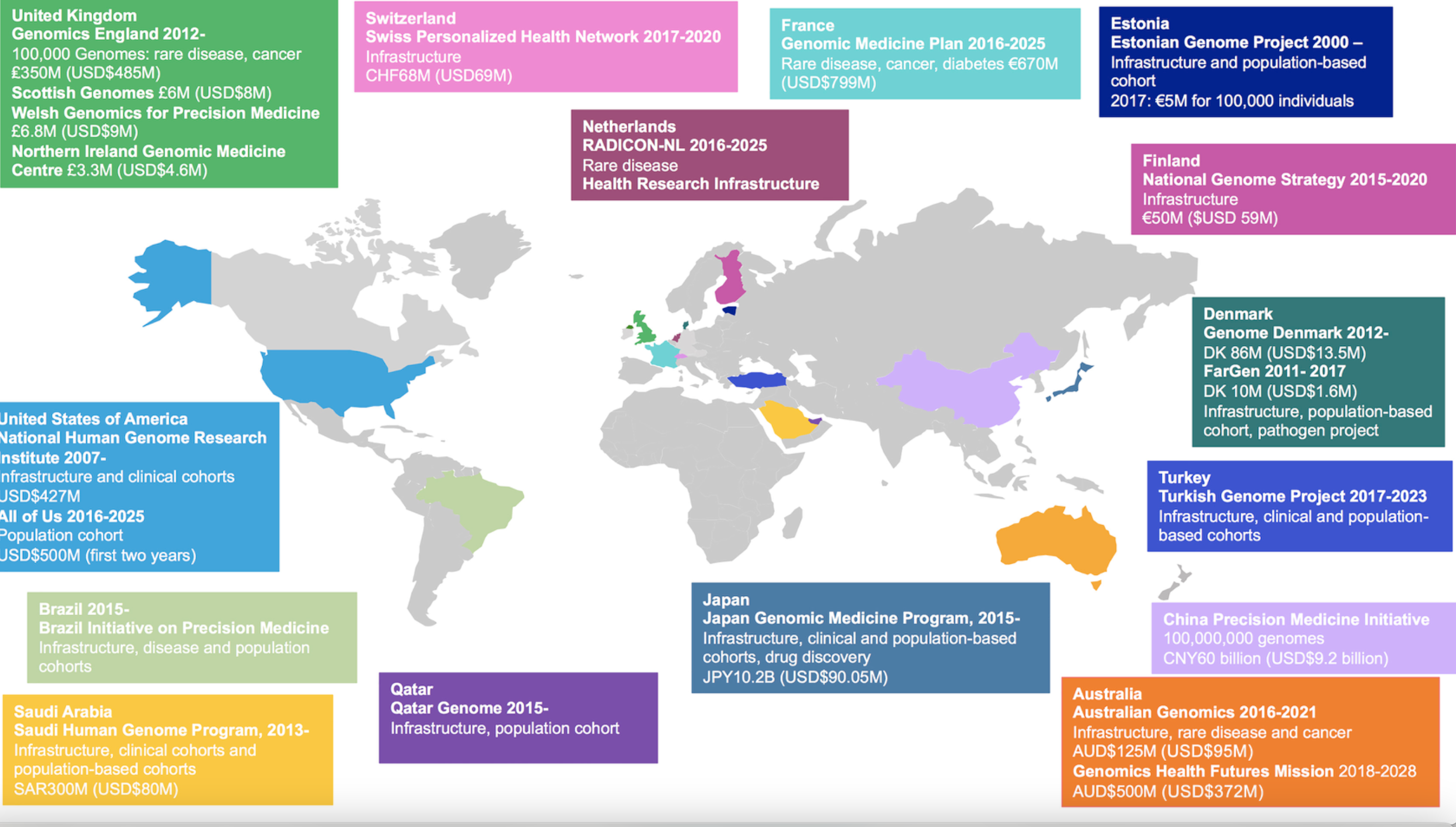
An international group of genomics experts advised in 2019 that there was a need to collaborate internationally on the development of genomics research and clinical services. They wrote in the American Journal of Human Genetics, “Genomic sequencing is rapidly transitioning into clinical practice, and implementation into healthcare systems has been supported by substantial government investment, totaling over US$4 billion, in at least 14 countries. These national genomic-medicine initiatives are driving transformative change under real-life conditions while simultaneously addressing barriers to implementation and gathering evidence for wider adoption.”
Figure 1 in this article showed government-funded genomics initiatives at the time:
Full article
The sector has continued to expand and develop since then. For example, Canada also have a genome library now, inspired by work in the UK. Embedded in the governance is a panel of patients and caregivers. There is also increasing work on genomics in Asia. Of note are the Hong Kong Genome Project (40,000 participants), and the Singapore Genome Project (SG100K) (100,000 participants).
World Health Organization
In 2022, the World Health Organization (WHO) Science Council recognised the potential of genomics and produced a roadmap to accelerate access to genomic technologies and applications across all continents. The roadmap focussed on four overarching themes: promotion; implementation; collaboration; and ethical, legal and social issues (known collectively as ELSI).
A summary table of the WHO genomics programme of work was published in Nature Medicine magazine in 2024 and can be found here.
Watch this short video that WHO produced to inform the public about its genomics work:
This is an additional video, hosted on YouTube.
Improving international collaboration
Stronger links between genomics initiatives can be made if there is more consistency in the ways that genomic data is collected, classified and stored. Several international organisations have been established to promote collaboration and interoperability within genomics, including GA4GH (Global Alliance for Genomics and Health).
In November 2024, the World Health Organization published Guidance for Human genome data collection, access, use and sharing. The guidance aims to promote trustworthiness, inclusiveness, good stewardship and common standards in genomics initiatives around the world.
Recommendations with particular relevance to our course include the following:
- Individuals and their representative communities should be engaged in the governance and decision-making process regarding collection, access to, use and sharing of human genome data, including the development of appropriate informed consent models and processes (section 3.1)
- Capacity building and strengthening [for the community] should be considered as part of any collection, access to, use and sharing of human genome data (section 3.4)
- To promote collaborative decision-making and effective partnerships, efforts should focus on building and strengthening capacity and improving health literacy on genomics and human genome data among all stakeholders. This includes both those contributing their data and those involved in making decisions about its collection, access, use, and sharing (section 3.5)
- Systems and mechanisms should be put in place to enable communication with individuals, families and communities about the use of their human genome data, and related research results. This should include plain language summaries of key insights and education materials and should be openly available to all (section 3.7).
Importance of patient advocacy
The essential role of patient advocates in genomics has been widely recognised by international bodies for many years. As long ago as 2015, the European Council emphasised the importance of patient involvement in five key areas: policy, health literacy, education and training for health professionals, early dialogue and advice, and safety (European Council ‘Conclusions on Personalised Medicine for Patients).
Global Genomics Education and Training
Large-scale genomics projects can only succeed if there is also a trained workforce to deliver genomic medicine in practice. Building that workforce is a challenge worldwide.
NHS England hosted an International Genomics Education and Training Summit in Cambridge, UK in November 2023. Clinicians, researchers and educators from 46 countries came together to share good practice and develop ideas for how to move genomics forward globally, recognising that education of a growing workforce will be key.
They noted that only a few countries currently offer postgraduate qualifications in genomics, and that some essential roles, such as genetic counselling, are not recognised professionally in many places. These barriers make it harder to expand the clinical workforce that is needed for genomic medicine to reach more patients.
Workforce training is not only about technical knowledge and skills—it also needs to prepare clinicians to work with patient advocates. At the Cambridge meeting, opportunities for advocacy were still limited, with most interactions shaped by traditional patient–clinician relationships. By the second Summit in Athens (February 2025), this gap was beginning to be addressed: the programme included a workshop on patient advocacy, delivered by advocates themselves (including one of our educators, Jillian Hastings Ward). The session highlighted to clinicians both where advocacy can add value—such as in service design, policy, and research—and how advocates can be effectively involved. This recognition of advocacy as part of workforce training is a crucial step towards embedding patient partnership in genomic medicine.
The Power of Patient Advocacy in Genomics: Influencing Research, Clinical Practice and Decision Making

The Power of Patient Advocacy in Genomics: Influencing Research, Clinical Practice and Decision Making





