
Why researchers need participants
In this section, we will explore some of the ways that people with lived experience of a health condition can influence genomics research and ultimately healthcare.
Patients as research participants
Researchers are keen to maximise the numbers of people taking part in genomic research. Including large numbers of participants in medical research and clinical trials can help researchers to obtain more accurate, reliable, and generalisable results, while also permitting analysis of different segments of the population. This can help them to draw meaningful conclusions that can lead to developing effective and safe medical therapies and practices.
As we will discuss further next week, having greater diversity in the genome data helps to make the research findings more applicable to a larger proportion of the world’s population. Importantly, what is learned in research often flows back into clinical care – improving how conditions are diagnosed, how treatments are chosen, and how care is tailored to individual patients.
But researchers need participants for more than the data they provide. Patients and research participants bring with them a wealth of lived experience and may be able to inform the researchers directly about what they would be most keen to improve in terms of patient care or longer term outcomes: researchers need patients to help them focus their work on the areas of greatest potential benefit.
Patients as research partners
It is important for people with lived experience to shape research so that it is carried out with or by patients and not to or for them. Researchers can consult, collaborate or partner with patients at all stages of the research cycle. This enhances the relevance, quality and impact of research findings, ensuring they are meaningful and beneficial to those who will be most affected by them. See more in Step 4.2.
The graphic below, co-produced with patients at the Cancer Research UK Cambridge Centre, sets out in more detail the different ways that patients and the public can be involved in research.
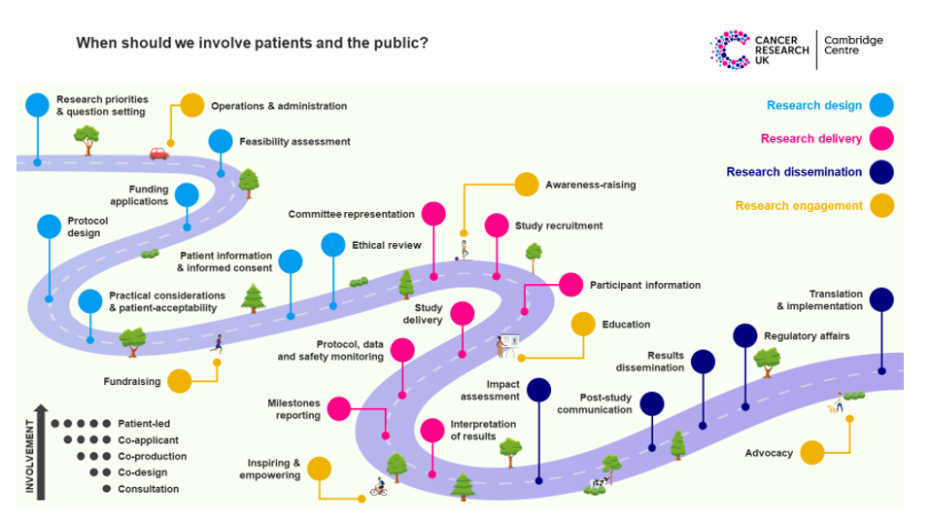
This graphic helpfully differentiates between design, delivery, dissemination and engagement activities in research. It also includes a depiction of different levels of ‘involvement’ (in the bottom left corner). We will return to these concepts in more depth later in the course.
Here are two perspectives from a patient partner and a clinical cancer geneticist on why patient involvement in research is important.
As a colorectal cancer survivor living with a permanent stoma, I’ve spent over a decade navigating life beyond diagnosis—not just for myself, but for others like me. Through my advocacy work across the region and with the Ostomy Association of Singapore, I’ve seen how vital it is to include patients from the start—not as token voices, but as true partners in research. When patients are involved meaningfully, the science becomes more humane, the questions more relevant, and the outcomes more impactful. Especially in fields like genomics, where trust, understanding, and ethical complexity intersect, patient insight isn’t a bonus—it’s a necessity.
— Ellil Mathiyan Lakshmanan, Patient Advocate, EUPATI Fellow and President of the Ostomy Association of Singapore
The best research one can do is to talk to people was very sound advice given to me- only through engaging with patients and their families can we truly understand what the unmet needs are for patients with genetic disorders. This advice has served my team very well in prioritising research questions that we tackle.
Joanne Ngeow, Assoc Professor of Genomic Medicine, Lee Kong Chian School of Medicine, Nanyang Technological University, Singapore; Head, Cancer Genetics Service, National Cancer Centre Singapore
Why researchers need public support
Public involvement has been a key priority for several prominent human genomics research initiatives globally, especially those which are funded by national governments and other public bodies. As well as raising the profile of these initiatives, with the aim of increasing the numbers of participants, public involvement can also help to ensure that research is conducted in an ethical, accessible, and transparent manner, and thereby maintain public trust.
If you wouldlike to read more about this topic, take a look at the way public involvement is explained by these human genomic research projects, in Australia and the UK:
The NHS Health Research Authority notes that overall, ‘public involvement throughout a study can help to make research ethical by:
- Making research more relevant – so that the research results are more likely to be useful and of benefit to patients and the public
- Helping to define what is acceptable to participants – particularly in controversial or sensitive research
- Improving the process of informed consent – making it easier for prospective participants to understand the research and potential risks
- Improving the experience of participating in research – checking that the practical arrangements for participants are appropriate and a respectful use of people’s time
- Improving the communication of findings to participants and the wider public – providing information on the progress of the research as well as the final results.’
Further details on each of these points can be found here.
Note: we would argue that ‘public involvement’ in this sense is even stronger where it includes people with lived experience.
Discussion questions:
Please study the CRUK map presented above:
Have you been involved in any genomics initiatives, as a member of the public or as a patient or patient representative? What did that involvement look like? What was the impact?
The Power of Patient Advocacy in Genomics: Influencing Research, Clinical Practice and Decision Making

The Power of Patient Advocacy in Genomics: Influencing Research, Clinical Practice and Decision Making





