
Spectrum of participation
Let’s look at a spectrum of participation framework
One framework from Australia describes a continuum ranging from participating in research, which involves contributing data but not influencing the research agenda, all the way to co-production. ‘Research co-production is an umbrella term used to describe collaborative approaches to knowledge generation that bring voices and perspectives together to uncover collective solutions.’ (for the citation see the attached source). Or simply put, research co-production means working together and sharing ideas to better understand something and find solutions as a team.
Although this continuum was used in a different field of research, it works well for genomics.
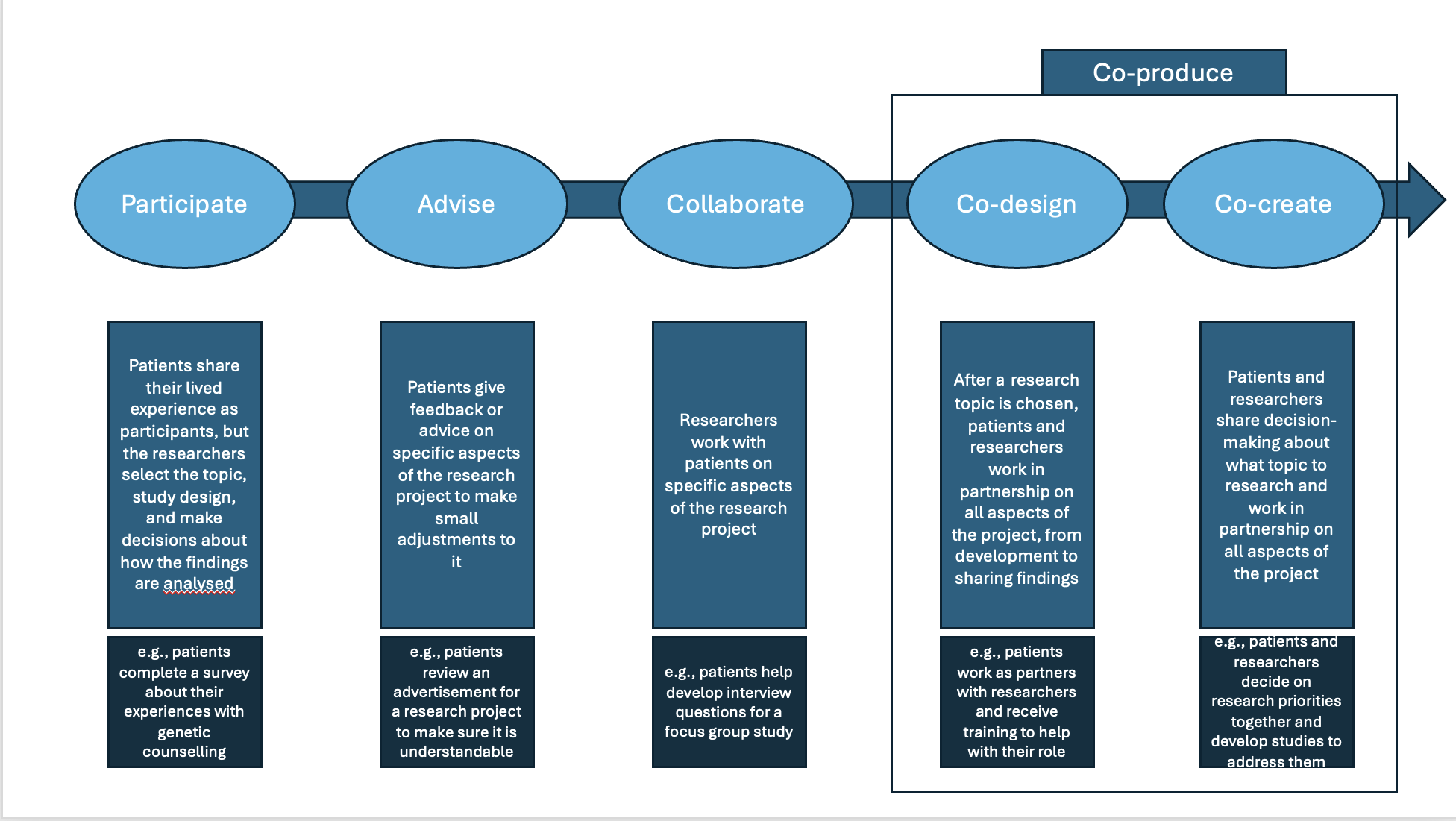
Adapted with permission: Lamb, K., Dembele, L., Nina, Fiona, Hegarty, K (2023). An Australian Framework for the ethical co-production of research and evaluation with victim survivors of domestic, family, and sexual violence, University of Melbourne: Australia.
Contributing data as a research participant is not a form of partnership in research, but it is often the first step that patients take when they start contributing to research. For example, patients may be asked to participate in a clinical trial of a new treatment.
At all the other points along the continuum, patients are partners in research. They bring the expertise of their lived experience to impact the research. One point along the continuum is not necessarily better, or more influential, than any other point. Rather, each of the points reflect different ways that people with lived experiences may impact the research.
For example, when asked to advise on a research project, patients may be asked to comment on whether an advertisement to recruit participants is easy to understand.
When collaborating on a research project, you contribute more to shaping the research, like whether the outcome being studied matters to patients or a sector of the public.
When co-producing research, you share in the decision making about what research will be done and how it is done. In this way, patients and researchers share power and decision making about the research.
In collaboration with academic researchers, patients may choose different ways to contribute depending on their interest in a project, how much time they have available, and how far along the research project is. For example, if you only have a small amount of time to contribute, you may be interested in commenting on whether the survey questions being asked of research participants make sense to you. If you have more time available and are interested in having more impact on research, you can explore whether it is a good fit for you to work together with academic researchers to decide on the methods for a research project.
Later this week, you will see a case study of how patients can advise on research. In week 4, you will see various case studies that demonstrate how patient partners collaborate on and co-produce research.
Whenever patients are partners in research, regardless of how they contribute, it is expected that their time and expertise are respected. This is covered in more detail in week 4 step of the course.
The Power of Patient Advocacy in Genomics: Influencing Research, Clinical Practice and Decision Making

The Power of Patient Advocacy in Genomics: Influencing Research, Clinical Practice and Decision Making





