
The challenge of multi-grade teaching
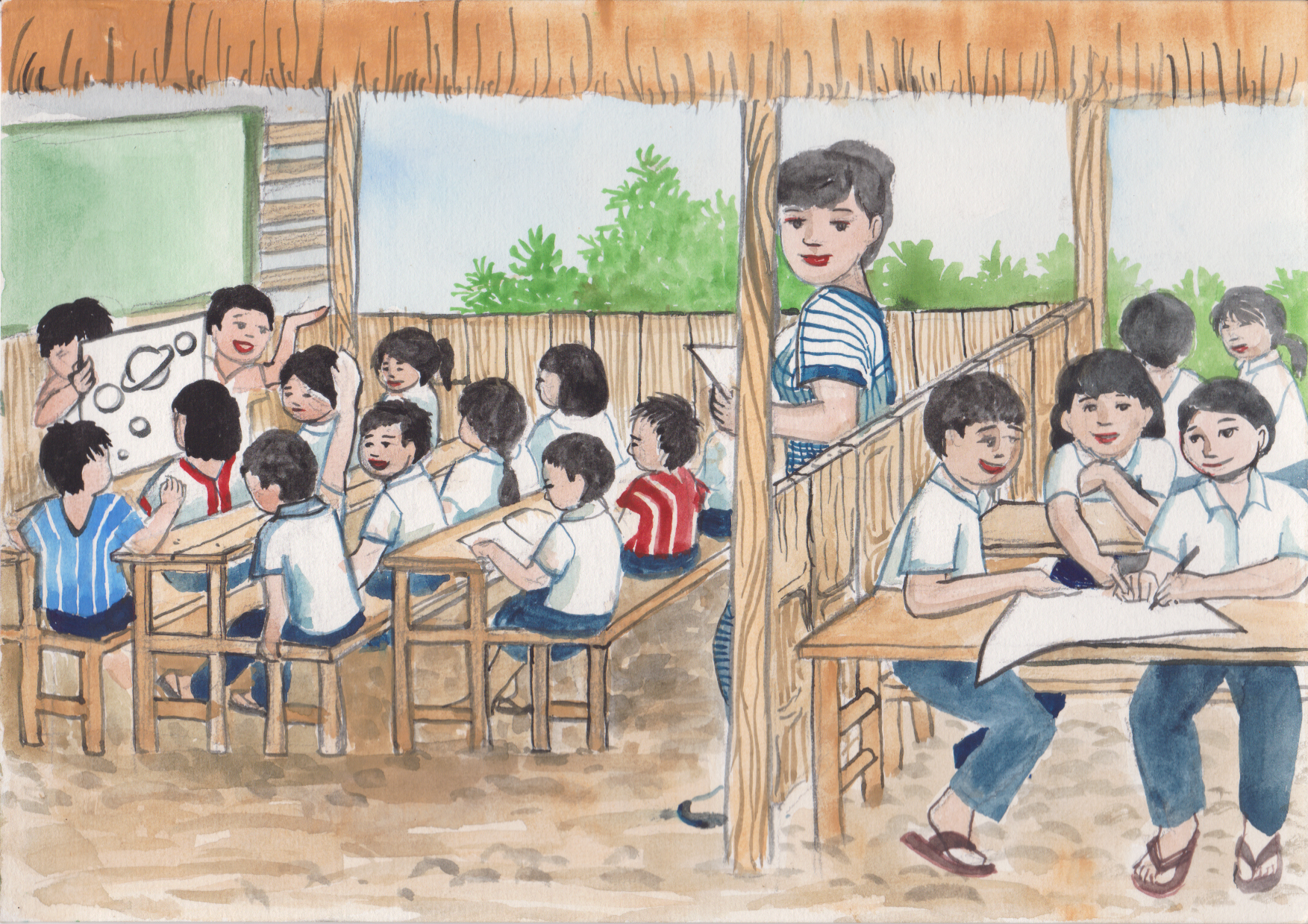
As the video shows, when there are not enough teachers or classrooms, one teacher may need to teach students from different grade levels in the same room. In this type of classroom, managing behaviour and keeping all students engaged can be very difficult.
In the video, the teacher explained how she teaches two different grade levels at the same time. She uses several different strategies. We can look closely at each strategy to understand its advantages and possible disadvantages.
Peer learning
Let students teach each other, form groups, and take on special responsibilities.
- Advantage: The older students learn more deeply when they help younger students, because they must think carefully about what they know and explain it clearly. The younger students get extra support and help.
- Possible disadvantage: The older students may not always explain things clearly or correctly.
Set tasks
While one group of students works on a task, the teacher moves to the second group to explain their activity and help them start. When that group is working, the teacher returns to the first group to check their work and discuss what they did.
- Advantage: Both groups are actively learning and receive feedback (comments and guidance) from the teacher.
- Possible disadvantage: The teacher has very little time to explain the ideas, topics, or methods in detail to either group.
Reward system
Encourage students who do well to come forward and share their answers with the class.
- Advantage: This rewards students who focus and work hard. It shows them their effort is valued.
- Possible disadvantage: Students who are struggling may feel left out or discouraged. Giving everyone a ‘class clap’ (group applause) may help them feel included, but only a little.
When we look at the possible disadvantages (problems) of these techniques, we need to find ways to avoid them. Some teachers have found they can improve peer learning by using the “teachback” technique.
Teachback technique
This is when one student teaches a concept to another student, who must ask questions to make sure they understand. A third student watches and notes any problems that come up.
Here is how to use the teachback technique:
- Put students into groups of three. Give each person a role: Teacher, Student, and Observer.
- The Teacher explains a concept or method to the Student. The Student must keep asking questions if they do not agree or do not understand (2-3 minutes, or longer if the topic is more complicated).
- The Observer notes any problems or questions that are not resolved.
- While the groups are working, the class teacher walks around and listens to what they are saying. He or she notes any points for discussion with the class later.
- The Observer from each group reports any remaining problems or questions to the whole class (about 2 minutes each for 10 groups to report back).
- The class teacher gives feedback on each of the problems that came up.
You can repeat the same exercise with two more topics. This way, each student has a chance to play all three roles: Teacher, Student, and Observer. This means every student is actively learning when they teach and when they are taught. All students also hear the teacher’s feedback on all the problems that come up.
Set tasks are useful, but teachers may wonder: when do I have time to actually teach? You can modify this method by using pre-class and post-class guided study (learning activities that students do before and after the lesson, with clear instructions from the teacher).
Use homework to extend the time available for learning. This allows you to run the class as two parallel sessions (two groups learning at the same time):
| Group 1 (younger) | Group 2 (older) | |
|---|---|---|
| Before class | Preparation | |
| In class | Teacher presentation | Practice in class |
| In class | Practice | Teacher presentation |
| In class | Peer feedback | Practice |
| In class | Teacher feedback | Peer feedback |
| After class | Teacher feedback |
The older group may be able to prepare before class. For example, they could read a text or listen to a recording at home. Then, for the first 10 minutes of class, they can work on practice activities based on what they prepared. Even if the students are very young, you can give them a simple worksheet (a paper with instructions and activities) to guide what they should do at home.
Both groups follow the same learning sequence: presentation (when new information is introduced), practice (when students try out what they learned), peer feedback (when students give each other comments and suggestions), and teacher feedback (when the teacher gives guidance). Both groups will probably need all of these steps.
The older group can hand in the work they completed after receiving peer feedback. The teacher can then give feedback on this work later.
ePortfolio Task on multigrade teaching
Use the provided template and design your own lesson plan for a class session. You can design this for your own teaching or to share with other teachers who work with multigrade classrooms.
Your plan should include activities for two groups of learners. For each group, write:
- The ages of students in the group.
- The learning outcome/s (what students should be able to do by the end of the lesson).
- The duration of the whole lesson (how long the lesson will take), including any pre-class work (preparation students do before the lesson) or homework.
- The sequence of teaching-learning activities (the order of activities in the lesson)
For each activity, include:
- How long it will take.
- What type of learning it provides in terms of the Conversational Framework.
Your plan should be realistic. The teacher should be able to manage both groups in one classroom, or in classrooms that are close to each other.
Using the ePortfolio template, explain how your planned activities will help motivate students to learn . You can also refer to other theoretical concepts (teaching ideas or models) you have studied to explain your design choices. Then reflect on what you would find most difficult about planning this lesson and then teaching it in your classroom. Your text should be approximately 350-500 words.
Over to you
What was your experience when you tried this exercise? Were you able to create a plan that could work in your classroom? Are there specific challenges in your situation that would make it difficult to use this plan?
Please read and comment on what other teachers have written. You can offer ideas for them to try or give feedback on their suggestions. Together, we can build a collection of good ideas for teaching multigrade classrooms!
Transforming Learning in Conflict and Crisis Settings

Transforming Learning in Conflict and Crisis Settings


