
Collaboration in agile
We have already learned that agile involves a number of ceremonies, or regular meetings. In this step, we will explore what these are and how user researchers can contribute to each of these to ensure that research is prioritised and that the whole team is involved.
Agile ceremonies
Sprint planning
Sprints are short, focused periods of work that normally last for around 2 weeks. At the start of each sprint, the whole team assembles for a sprint planning meeting.
During this meeting, the team identifies what work can be delivered within the 2-week sprint and how this can be achieved. Careful planning sets teams up for success – by the end of the meeting, every team member should be clear on what they are going to do and how.
It is vital that user researchers are involved in sprint planning because user research should be a key priority during every sprint.
Making time for research, analysis and discussion of findings during each sprint keeps the team focused on users and helps everyone to maintain an open-minded, learning attitude throughout the project.
However, this is sometimes easier said than done!
Planning meetings are all about managing competing priorities between internal and external stakeholders. You need to ensure that research is not de-prioritised in favour of the team just getting on with building something. User research at all points in the development process is vital to ensure that the team stays on track and actually builds something that meets user needs.
Daily stand-up
Daily stand-ups are meetings of normally around 15 minutes where the team assembles to discuss progress in the sprint so far and identify any blockers they may be facing.
These meetings are called stand-ups because participants are encouraged to stand during the meeting as incentive to keep it short and then move on to their tasks for the day. However, while fun, this is optional – if your stand-up is held virtually due to remote or hybrid working in your team, feel free to stay seated at your desk!
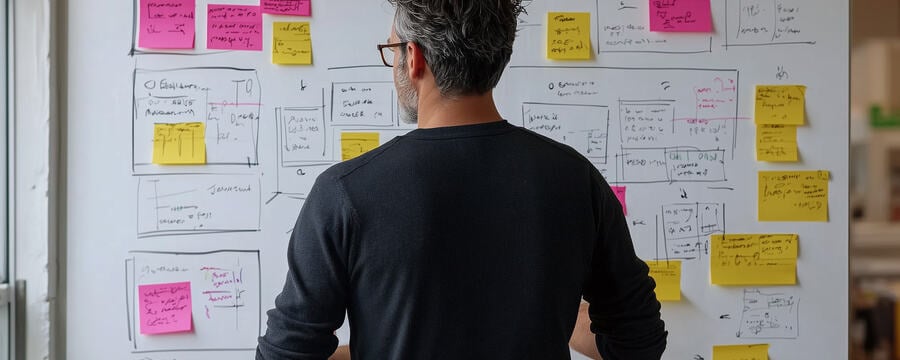
Daily stand-ups are always held at the same time each day during the sprint and they often take place at the team wall (either physically, in the office, or using an online equivalent) so that team members can visually point to what they have been working on. A team wall is a repository of information and a communication tool – we will learn more about this in the next step.
For user researchers, the stand-up is important because it is an opportunity to update your team on your research activities as well as emphasise the importance of keeping research a priority within the sprint plan.
As we know, user research is a team sport, and you should always encourage your team members to join research sessions as observers and to participate in data analysis. It is also good to know what your team is working on, to see if there are opportunities for you to join in other activities where you may be able to build up your knowledge or ensure your insights are supporting the work of other team members.
Sprint reviews and retrospectives
Sprint reviews and retrospectives both take place at the end of each sprint. A sprint review focuses on what work the team managed to complete during the sprint, while the sprint retrospective focuses on how the team worked during the sprint, thinking about their approach and the team dynamic.
Both meetings are valuable opportunities for user researchers to showcase their research to the team and different stakeholders.
A sprint review is often just between team members but it can also include external stakeholders, such as senior leadership.
The idea is that the team showcases work that is now “done”, which could include a new prototype feature or, in the case of user research, a new and exciting insight that was discovered during the research conducted during that sprint. It is a chance to celebrate achievements and get immediate feedback to be incorporated into the next sprint plan.
Celebrating achievements is important – the team may lose morale if the focus is constantly on what did not work.
A sprint review is also an opportunity to look back at the original sprint plan and determine whether it was too ambitious or too tentative and take this forward into scoping work for the next sprint.
Working in agile is about being flexible and adaptable as a team, fostering a culture of giving and implementing rapid feedback to improve working practices and cultures.
Retrospectives help the team understand what worked well and what did not, as well as give team members the opportunity to speak freely (but respectfully!) about how they feel about working in the team.
Retrospectives should highlight positives as well as areas for improvement. It is important to acknowledge and celebrate what is working as well as to address issues within the team.
Continuous research, continuous improvement
As we have learned through this week, user research is important in all phases of the service life cycle.
Agile working is about continuous iteration – incremental improvement based on data and feedback, testing, learning from failure and applying these findings in each new iteration.
As user researchers, you are an integral part of the team – your research findings and your advocacy for the users are fundamental to making the service work. By continuously discovering new insights about your users and applying this data to the service, you ensure that users remain the focus of what your team is doing and that the service will work for everyone as a result.
User Research in Government: Developing Further

User Research in Government: Developing Further


