
AMRrules – Open source rules for interpreting AMR data
You may have noticed throughout this course that different databases can link genes to different drugs or drug classes, using different nomenclature.
The AMRrules project is a global effort by the ESGEM-AMR Working Group (a European Society for Clinical Microbiology and Infectious Diseases Study Group, focusing on Epidemiological Markers) to develop interpretive standards for AMR genotypes to address this issue.
These standards aim to be similar to antimicrobial susceptibility testing standards, where rules for interpreting susceptibility tests for different microorganisms are regularly reviewed by EUCAST or CLSI
AMRrules plans to develop similar rules for organism-specific interpretation of AMR genotypes generated from whole genome sequencing data.
AMRrules has brought together >120 experts across 35 different organisms to develop rules. The final workflow will enable users to take the AMR genotype report from their chosen AMR gene finding tool, apply the ruleset for their organism, and create an annotated genotype report (Figure 1). Currently the project supports genotypes generated from AMRFinderPlus, with the goal of supporting additional tools in the future (CARD, ResFinder).

Figure 1: Workflow for AMRrules
Rules for organisms are given using a standardised table. An example can be viewed here. Each row of the table outlines an AMR determinant detected in an organism. The table lists, for that determinant, the type of determinant it is (variation type: is it the presence of a gene? A mutation in a gene?), and whether that determinant is core or acquired in that particular organism. The rule specifies what drug or drug class the determinant applies to, and what the phenotypic interpretation of the determinant should be (wildtype or nonwildtype, susceptible or resistant). For each rule, the type of evidence linking that determinant to a particular phenotype is listed using a controlled vocabulary (see the ECO system in the exercise of step 1.18), and publications describing this evidence.
When a ruleset is applied to an AMR genotype report, the interpretation software will annotate the report with information drawn from the rules (see example in Figure 2).
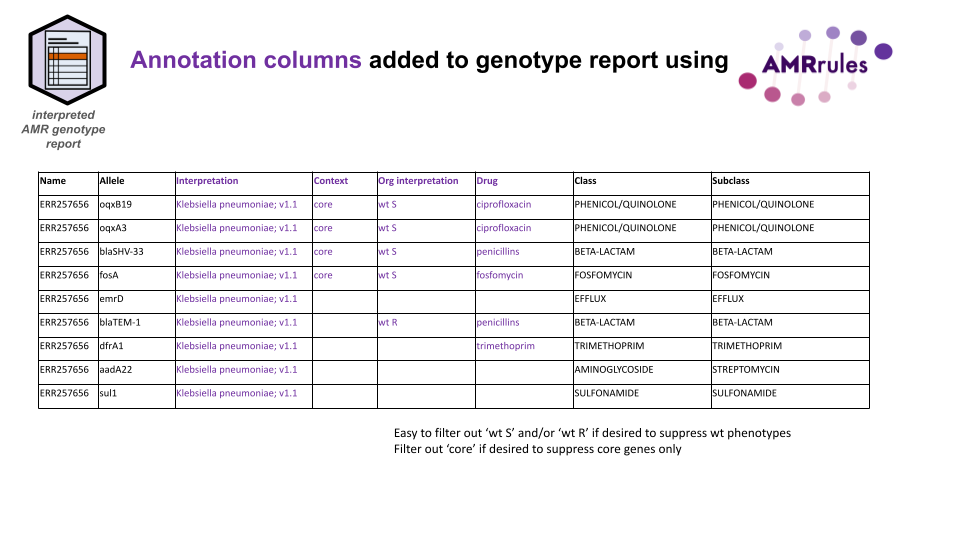
Figure 2: Example annotated AMRFinderPlus report using rules developed for Klebsiella pneumoniae. Columns in purple are those added by the AMRrules software.
AMRrules is an on-going project, with the first rule release and the interpretation engine being released mid-2025.
Antimicrobial Databases and Genotype Prediction: Data Sharing and Analysis


Antimicrobial Databases and Genotype Prediction: Data Sharing and Analysis





