
Case studies: integrating AMR data
Let’s look at the aspects of data integration and genomic epidemiology in our case studies.
Importance of data integration in understanding the spread of Kpn ST258/512
The integration of antimicrobial resistance (AMR) results with epidemiological information was central to understanding the spread of Klebsiella pneumoniae ST258/512, as demonstrated in the study by David et al. (2019). By linking genomic data with patient location, sampling dates, and hospital-level metadata, researchers were able to identify patterns of both local and interhospital transmission. Combining genomic analysis with epidemiological context allowed for the identification of transmission clusters and refinement of SNP thresholds for outbreak detection. This comprehensive approach provided actionable insights for national infection control and AMR mitigation strategies.
Relevance of genomic epidemiology
Genomic epidemiology played a pivotal role in revealing the dissemination dynamics of the ST258 clone and its close variant ST512. Through large-scale sequencing of over 600 ST258 and ST512 genomes, researchers uncovered that its global spread occurred via multiple independent introductions into different countries, followed by localized clonal expansion. This contradicted the assumption of sustained international transmission and emphasized the need for strong national surveillance systems. Tools such as ResFinder, CARD, and AMRFinderPlus enabled the identification of resistance genes and mobile elements, while phylogenetic analysis illuminated evolutionary relationships and transmission chains. These tools provided a detailed view of how resistance determinants, particularly KPC genes, were propagated within and between clones through both vertical inheritance and horizontal gene transfer.
The ST258 lineage showed extremely limited genetic diversity (average nucleotide identity of 99.9–100%), suggesting a recent and rapid clonal expansion. The study found that more than half of the ST258 isolates had their nearest genetic neighbor from the same hospital, indicating frequent within-hospital transmission.
Phylogenetic analysis revealed a likely origin for ST258 in the United States and for ST512 in Israel, followed by their dissemination into countries such as Italy, Greece, and others, where local outbreak clusters were documented. The resistance in ST258/512 was primarily due to blaKPC-like genes, notably KPC-3, especially in Italian isolates. While these genes are typically plasmid-borne, their spread in this lineage appeared to be predominantly clonal, underscoring the significance of hospital-based transmission in the propagation of these high-risk resistant clones.
You can follow the analysis at the following link Microreact of ST258/512.
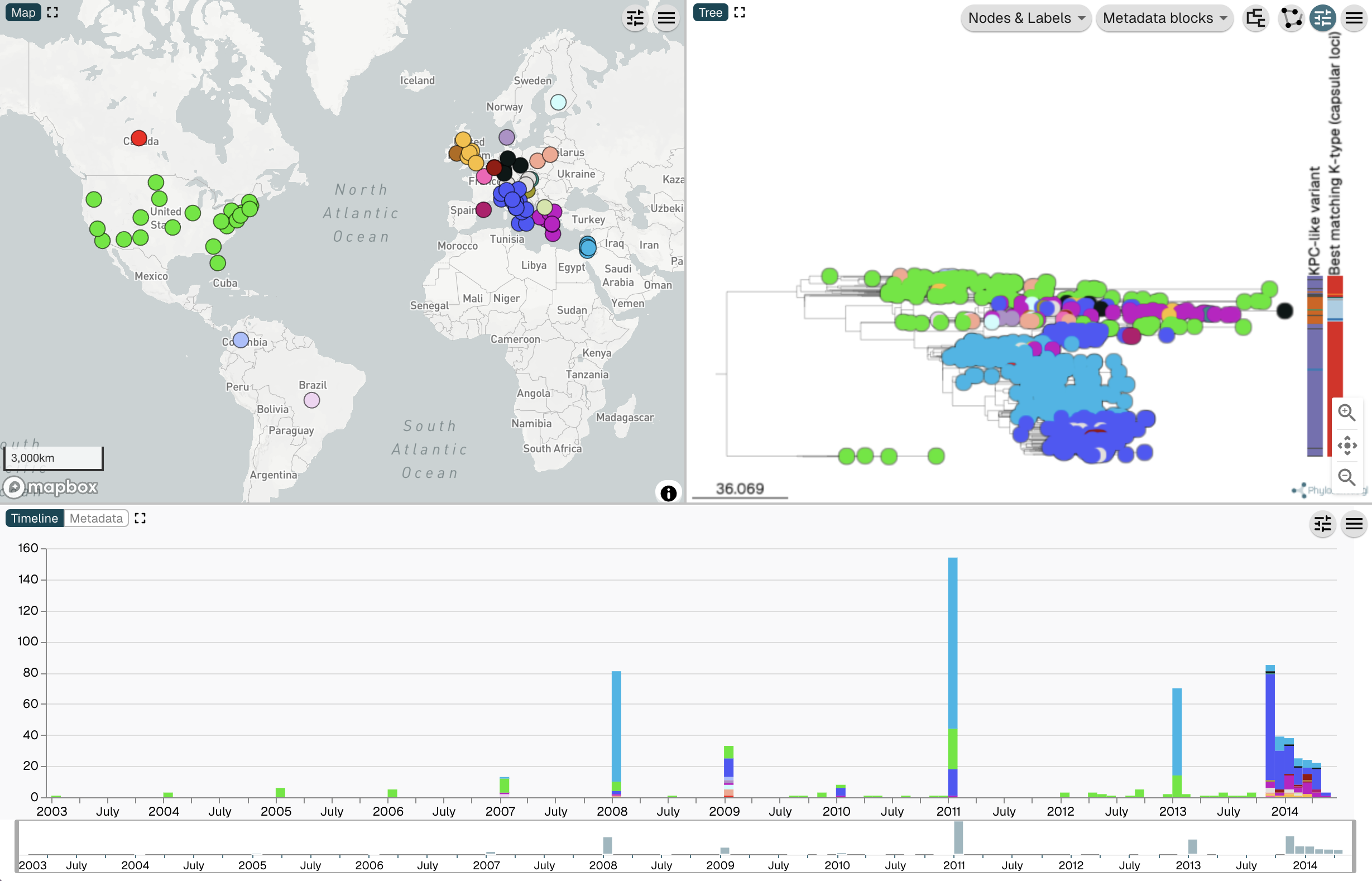
Figure 1: A Microreact visualisation of 236 isolates of ST258/512 from the EuSCAPE project, contextualised with another 415 other global isolates downloaded from public repositories.
Genomic epidemiology helps understand the epidemiology of carbapenem-resistant Acinetobacter baumannii ST2 in Oceania
This multicountry cohort study integrated clinical isolates of carbapenem-resistant Acinetobacter baumannii (CRAb) from Fiji,Samoa, Australia, New Zealand and India. By comparing isolates from Fiji and Samoa with the publicly available isolates from the other countries, the study was able to: detect unrecognized outbreaks, identify a common ancestral lineage of ST2 shared between Oceania and South Asia India), showcasing the movement of resistant strains across borders.
This level of insight was only possible through access to, and comparison with, sequence data shared by laboratories across countries.
Microreact of the ST2 isolates are here.
If you want to learn more about how Microreact can be used to integrate metadata with genomic epidemiology, you can view the documentation here
Antimicrobial Databases and Genotype Prediction: Data Sharing and Analysis


Antimicrobial Databases and Genotype Prediction: Data Sharing and Analysis





