
Applying metadata in AMR
What is metadata?
In genomics, metadata refers to any contextual or descriptive information that accompanies the raw sequencing data. This includes details that help interpret, compare, and analyze the sequence, especially in epidemiological, evolutionary, and surveillance studies.
Why is metadata important?
Metadata is critically important in genomics, in contexts such as pathogen surveillance and antimicrobial resistance (AMR) monitoring, because it provides the essential context needed to make raw sequence data meaningful, actionable, and reproducible. For example, the host from which a pathogen sample was taken can help identify zoonotic transmission routes.
Types of metadata
| Type of Metadata | Purpose | . Why It Matters |
|---|---|---|
| Place, time, location, host | Provides sample context | Links WGS to real-world scenario |
| AST, serotype, virulence | Analytical support | Enables phenotype-genotype association |
| Country, lineage, cluster ID | Comparative studies | Supports outbreak investigation and surveillance |
| Sequencing platform, sequencing protocols, Bioinformatics pipelines metrics | Quality control | Ensures reproducibility and trust |
| Institute / Hospital which commissioned the WGS | Public health context, Surveillance | Integrates data into national/global systems |
Let us revisit metadata in the context of the two real-world AMR case studies – Klebsiella pneumoniae ST258 and Acinetobacter baumannii ST2 – that we examined in the previous step to see how different types of metadata informed outbreak detection, epidemiological interpretation, and public health response.
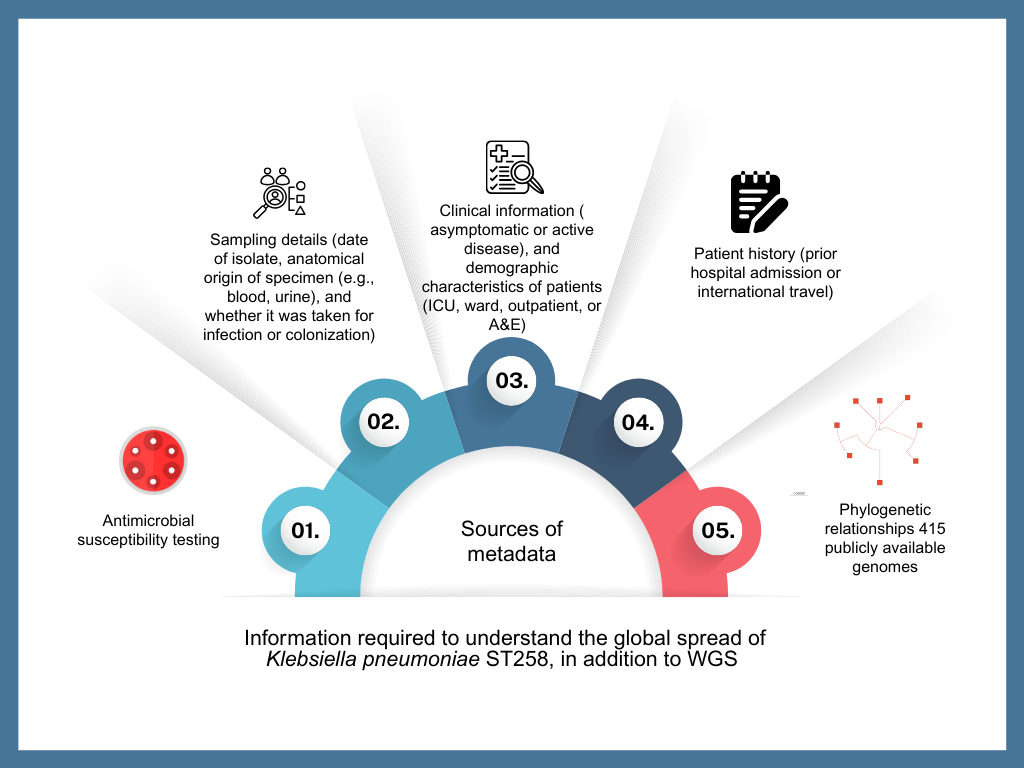
In the study of the Klebsiella pneumoniae ST258, authors collected patient-level metadata (e.g., specimen source, infection type, travel history), hospital-level data (e.g., size, admissions, catchment population), and geographic information. This metadata enabled researchers to link K. pneumoniae ST258’s spread to nosocomial transmission, particularly in large hospitals. By correlating isolates’ whole genome sequencing data with hospital and patient metadata, the study revealed how ST258 disseminated through regional healthcare networks, highlighting its dependence on hospital-based amplification and cross-border movement.
In the second study of CRAb outbreaks, authors collected clinical, demographic, and environmental metadata. This included hospital admission dates, patient ward locations, outcomes, specimen type, and antimicrobial therapy details. Whole-genome sequencing and resistance gene profiling were combined with patient data to uncover prolonged, undetected ST2 outbreaks. Metadata integration enabled the identification of nosocomial transmission routes and links between strains across Fiji, Samoa, and other countries, informing regional outbreak response strategies.
Antimicrobial Databases and Genotype Prediction: Data Sharing and Analysis


Antimicrobial Databases and Genotype Prediction: Data Sharing and Analysis





