
How do thermal bridges increase the risk of mould?
As with water (relative humidity and water activity), understanding the thermal properties of a building’s external walls is essential for maintaining a healthy indoor environment.
A thermal bridge (or cold bridge) is a portion of a structure whose higher thermal conductivity lowers its overall thermal insulation. Thermal bridges occur where the insulation is thinner or less effective than elsewhere in the building and is interrupted (‘bridged’) by other materials such as timber framing members, studs, joists and rafters.
Thermal bridges often occur:
- Where insulation is missing or thinner,
- Around window and door frames,
- At junctions between walls, floors, and ceilings.
Because these areas have lower internal surface temperatures, they’re at a higher risk of condensation, which in turn increases the risk of mould growth, especially when paired with high water activity in materials.
Thermal bridging, therefore, links the heat-loss and moisture mechanisms described earlier: cold surfaces lower the local dew-point margin, allowing water vapour to condense and sustain mould even when room humidity seems moderate.
The images below illustrate this relationship:
- Left: Infrared (thermal) image, showing the wall’s surface distribution. Cooler areas (blue tones) indicate thermal bridging, where heat is lost more quickly.
- Right: Visible-light image, of the same wall, revealing vertical bands of mould growth that align with the cooler thermal bridge zone, illustrating how reduced surface temperature contributes to moisture-related damage.
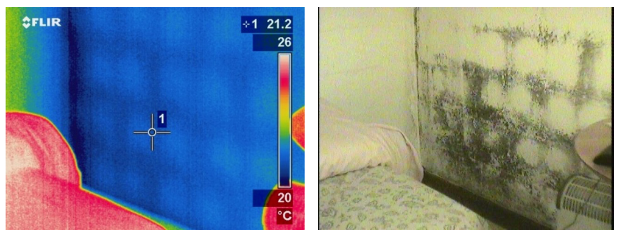
This comparison highlights how fabric heat loss and surface moisture interact. Infrared thermography is an effective diagnostic tool for locating thermal bridges before mould damage becomes visible.
Temperature factor
Because of the lower internal surface temperature at the junction, condensation can occur at a thermal bridge. The temperature of the internal surface of walls, can be influenced by both the wall’s thermal properties and the temperature differences between the exterior and indoor air.
This relationship is quantified using a temperature factor, fRsi , which ranges from 0 to 1. The temperature factor represents how well the wall is insulated, with a value close to 1 indicating excellent insulation.
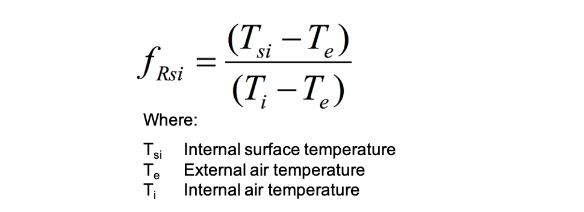
A high fRsi means the surface stays close to room temperature; a low value means the surface cools towards the outdoor temperature. For example, if Ti = 20 °C and Te = 0°C, an fRsi of 0.75 gives a surface temperature of 15 °C. At 60 % RH, the dew point is roughly 12°C, so condensation is avoided, but if fRsi falls below 0.65, the surface could drop near the dew point and mould risk increases sharply.
Standards for mould prevention
To reduce the risk of condensation, BS 5250 [1] recommends a minimum temperature factor of 0.75. Maintaining this value ensures internal surfaces stay warm enough to prevent condensation, and when combined with controlled relative humidity and water activity, it helps minimise mould risk.
Reference
1. BS 5250:2021 Management of moisture in buildings. Code of practice
Moisture-Safe Homes: Understanding and Managing Condensation, Damp, and Mould


Moisture-Safe Homes: Understanding and Managing Condensation, Damp, and Mould





