
Volcanic hazards
In this video, Dr Marc Alban-Millet introduces a range of volcanic hazards.
As we saw in the video, there are two main categories of hazards.
Primary
Caused by specific activity, such as ongoing eruptions.
Secondary
Caused by instability of the volcano.
Perhaps the most familiar hazards to us are primary hazards and more specifically lava flows. If you’ve seen any of the famous volcano disaster movies such as Volcano and Dante’s Peak, you’ll see lava flows featured.
Primary hazards
There are three main categories of primary hazards.
Lava
Lava flows are actually deemed to be one of the least dangerous hazards as it moves slowly. But, a lava flow can’t usually be stopped or diverted and they are extremely hot (reaching temperatures of over 2,000 degrees Fahrenheit).
Ash
Ash can be ejected high into the atmosphere, eventually spreading sideways to form a large cloud. From the cloud, ash particles rain down and impact everything in its vicinity. The coarser ash particles land closest to the volcano. The finer ash particles can be picked up strong winds and travel thousands of miles from the erupting volcano.
Ash can also flow down the sides of the volcanoes at speeds of up to a few hundreds of kilometres per hour. They are called pyroclastic flows and are made up of hot ash and gases.
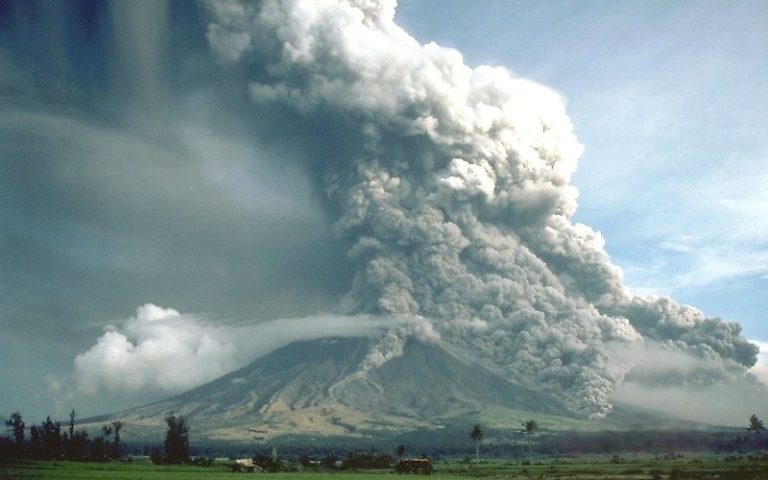 Pyroclastic flows at Mayon Volcano, Philippines, 1984 by C.G. Newhall, Public Domain
Gas
Volcanoes can emit gases which can harm us and lead to deaths. Gases such as carbon dioxide and sulphur dioxide can also impact our climate, causing warming and cooling respectively.
Secondary hazards
Rock Avalanches
Structural collapse of volcanoes can cause block and ash flows, which are essentially rock avalanches. These are secondary hazards.
Lahars
Lahars are another secondary hazard and they are mud and debris that flows down the sides of volcanoes. They are mobilised by water and can be incredibly destructive. These occurred as a result of the recent 2018 eruption of Volcán de Fuego, Guatemala.
In the next step we’ll investigate and discuss volcano risks and provide opportunities to explore some specific examples.


