
Calcium and Weight Loss
Daily calcium intervention improves the effectiveness of calorie-restriction weight loss programs in overweight or obese humans.
Yen-Ling Chen, Yi-Chun Chen, Jo Chun Lin, Yi-Wen Chien
Calcium and Weight Loss Study
The purpose of this study was to assess the impact of dietary calcium intervention on the effectiveness of a weight loss program for obese people. All subjects had an initial BMI (body mass index) >24 kg/m2 and low calcium diet (<500 mg/d).
Forty-two healthy overweight or obese people were randomly and equally divided into two groups: a Hi-Ca group (female: 16, male: 5) and a control group (female: 16, male: 5). In the Hi-Ca group, we provided two bottles of Hi-Ca drinks per day and a low energy diet (energy: 1200 kcal, carbohydrate: 55%, fat: 25%, protein: 20%) for eight weeks. In the control group, we only provided the low-energy diet for eight weeks. We measured three-day food records, anthropometric and blood biochemical data at Weeks 0 and 8. Calcium intake was 964.5 ± 75.5 mg in the Hi-Ca group and was 353.7 ± 96.6 mg in the control group (p<0.05).
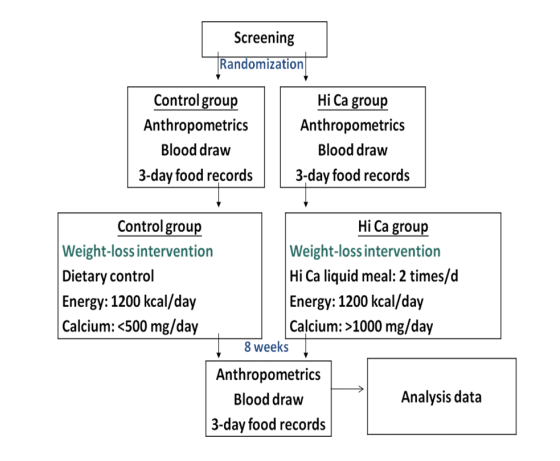
After eight weeks, results showed the loss of body weight (-6.9 ± 3.3 kg, p<0.05), BMI (-2.7 ± 1.1 kg/m2, p<0.01), body fat mass (-5.7 ± 2.7 kg, p<0.05), body fat percentage (-4.4 ± 1.9 %, p<0.002) and TC/HDL-C (-0.4 ± 0.6, p<0.05) in the Hi-Ca group were significantly different from those of the control group at eight weeks. In the lipid profile, serum cholesterol, triglycerides and LDL-C concentration were significantly decreased compared with Week 0. The serum PTH (parathyroid hormone) levels in the Hi-Ca group were significantly lower compared with baseline (-5.3 ± 10.4 pg/mL, p<0.05), which showed that the concentration of PTH and calcium intake are negatively correlated, and indicate that a high-calcium low-energy diet resulted in more significant decreases in body weight, BMI, body fat mass, and body fat percentage.
Therefore, a high calcium diet increases the effectiveness of an energy-restricted diet for weight loss in overweight and obese people.
Reference in the introduction that this article is from a research study, and learners can read the paper in full in the Downloads area.
Introduction to Nutrition and Food Safety





