Huge explosive volcanic eruptions in the Tropics, energetic enough to push sulphur gases up into the stratosphere where they condense into aerosols, can have a cooling effect on climate by …
In the next Step you’ll be able to consolidate what you’ve learnt so far by reading a weather map. Let’s first summarise what has been covered. Weather systems act to …
The polar front jet stream is a belt of westerlies in the upper troposphere, with wind speeds up to 200mph. It sits at a around 10km, the height at which …
If a depression were passing over you, when would you expect there to be cloud, what sort of cloud would you see, and when would it rain? Please note diagrams …
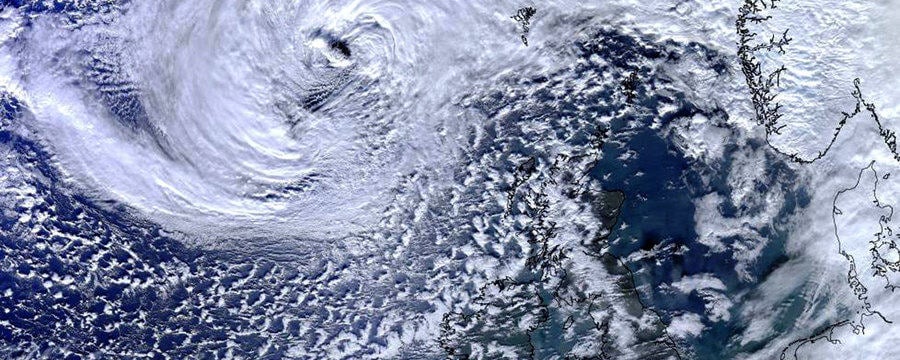
We now know that a Polar front is the boundary which separates warm tropical air from the colder air near the pole. All depressions form on this Polar front, because …
Before you start the course, we’d like you to have a go at trying to predict the weather in Reading, in our game hosted on the Royal Meteorological Society website. …
Of all the weather systems on Earth, tropical cyclones produce some of the most intense and damaging weather. Known as Hurricanes in the Atlantic, Typhoons in the Pacific and Cyclones …
The word ‘monsoon’ tends to be used very loosely to describe any particularly prolonged spell of wet weather. In fact the word has a very specific meteorological meaning. It is …
Every few years a very noticeable change comes about in the temperature of the equatorial Pacific Ocean. The eastern side, which is usually the coolest part, warms up considerably, particularly …
Earlier this week we looked at the radiation budget of the Earth, that is the difference between the incoming energy from the Sun and the outgoing infra-red energy lost to …
Congratulations on completing the course! Hopefully, by the end of this week you should feel that you are happier: explaining some of the processes which transfer energy through the Earth …
In this video Sylvia demonstrates the solutions to this Week’s practical activity; the isoline drawing exercise in Step 3.11. We have also provided the solutions for the exercise on a …
This week is your last chance to submit your prediction in the weather forecasting game, or to see if you can improve on your score from the previous week. If …
Now that you have seen the demonstration of the Coriolis effect in Week 1, let’s look at how this tank of water represents the atmosphere rotating with the earth. Pete …