In Week 1 you explored how rain forms when air cools, the rate of condensation becomes faster than the rate at which water is evaporating and cloud droplets form. If …
In this activity, your task is to work out what the weather was like in the UK, from the three weather maps provided below. Your answers must be based, only, …
Now you’ve completed the quiz in the previous Step, take a look at the table below which summarises what is happening to the air from the four major air masses …
Let’s think about the properties and characteristics of the air reaching the UK. Let’s start with the concept of air masses and consider the properties of the air that will …
In this second exercise, your task is to identify what the weather is currently doing in each of the marked examples (Figures 1–4). Don’t worry about how the weather might …
In this video, Pete uses a turntable and a ball to simulate the effect of the Coriolis force. The ball is deflected on a curved trajectory, across a rotating surface, …
In Step 1.10 you explored why cloud and rain are associated with a depression. But why are they low pressure systems, and how do we get wind? First of all …
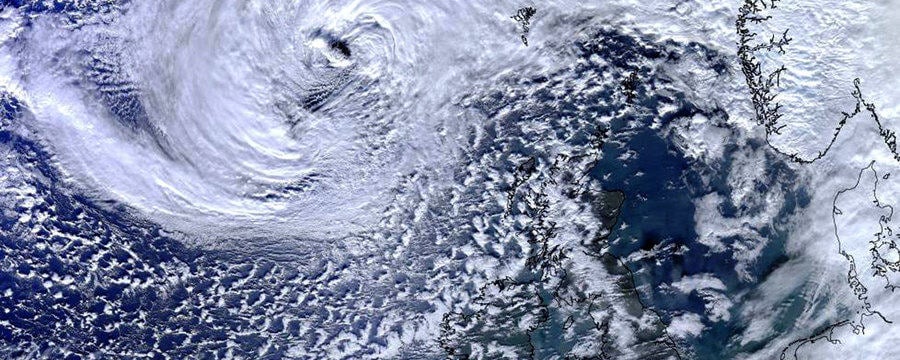
Mid-latitude depressions are areas of low pressure located between 30° and 60° latitude, causing unsettled weather and rain. The winter of 2013/14 brought 12 major mid-latitude depressions to the UK. …
Congratulations on reaching the end of Week 1! Hopefully, you feel that you have a better understanding of the weather systems which bring the UK, and other mid-latitude countries most …
Join Sylvia to find out how you got on this week. In this film Sylvia demonstrates the solutions to the weather map exercises in the previous two Steps, and explains …
Please note you may find some of this material challenging. If you find yourself getting stuck don’t worry – help is on hand. Raise your questions in the comments area …
In this Step we explore two case studies that provide further insight into conveyor belts. October 28 2013 The animation above, provided by the Met Office, is from the St. …
Please note you may find some of this material challenging. If you find yourself getting stuck don’t worry – help is on hand. Raise your questions in the comments area …
In this video Sylvia demonstrates how changes in pressure result in cloud formation, using a plastic bottle and a bicycle pump. The bike pump increases the pressure, and therefore the …